About the Book
Waiting At The Gate
How God Shaped the Soul of a Dog, and Why You'll See Yours Again
by Dr. Greg Cynaumon
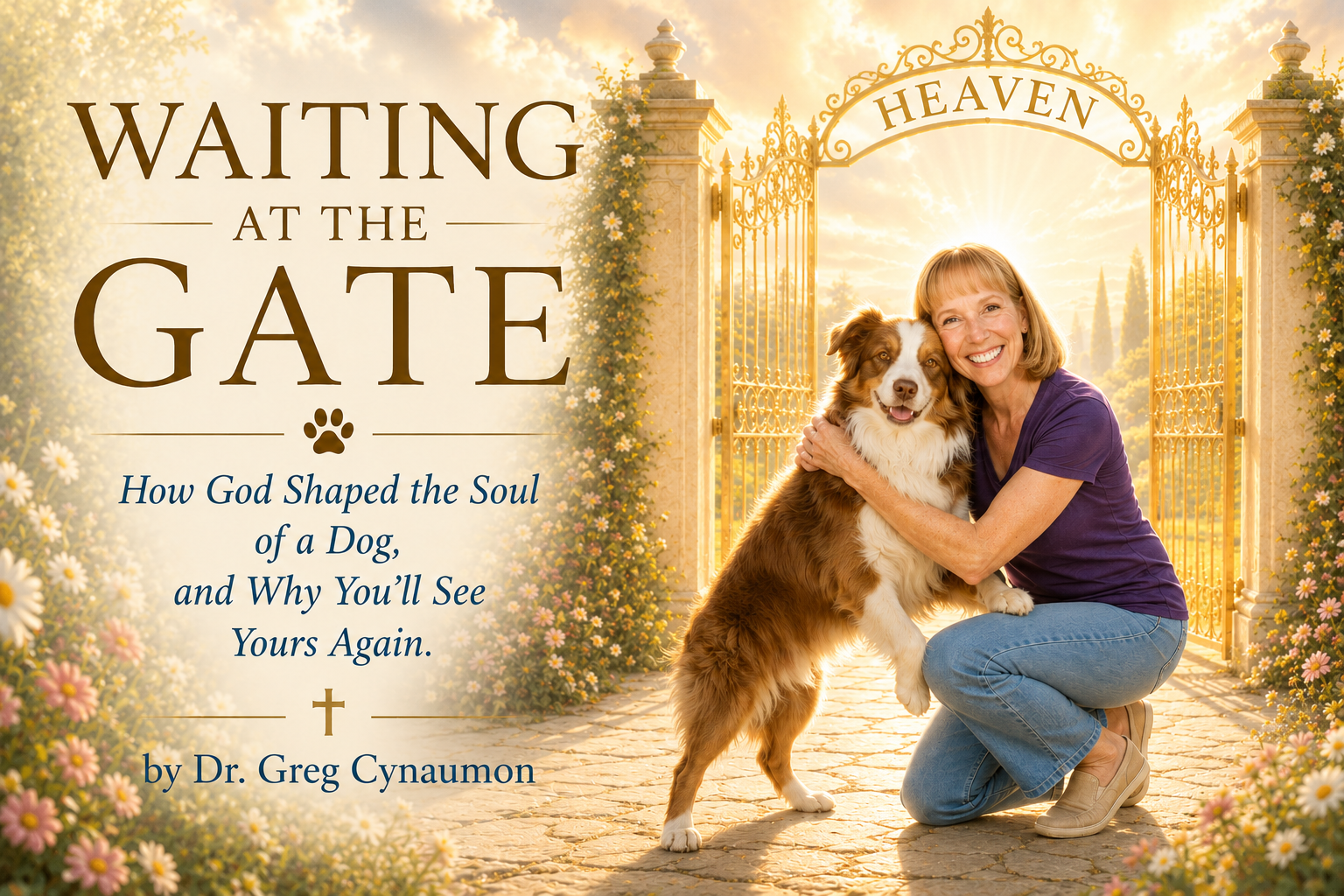
For everyone who has loved a dog — and especially for those who have lost one.
The week after I lost my father, I sat alone in my office with my Bible open in front of me and tears I couldn't seem to release. I sat in complete silence just feeling my grief.
Then I heard him coming down the stairs.
Bud — my Australian Shepherd — walked slowly into my office, rested his head on my knee, and stared up at me. He didn't whine. He didn't nudge. He just looked at me with what I can only describe as recognition. As if to say: I know.
I have spent decades studying human behavior. I served ten years in law enforcement as an undercover Narcotics Detective and SWAT hostage negotiator. I have practiced as a Doctor of Psychology, sitting with patients through every kind of grief and crisis. And in that moment in my office, with Bud's head on my knee, I began to suspect I had spent decades studying the wrong species.
Dogs know something we have forgotten.
I have stood next to a K-9 handler on a callout and watched his dog read something in his face that no one had spoken aloud. Before the command came, before the handler had so much as shifted his weight, the dog was already moving toward an armed suspect — without hesitation, without calculation, without being told. I have watched a therapy dog cross a room and put her head in a patient's lap minutes before the patient knew a panic attack was coming — before I knew, and I was trained to see it. The dog was already there providing comfort when it hit. And I have sat in a downstairs office in the week after my father died, not crying, not making a sound, and heard a dog start down the stairs.
Three dogs. A standoff, a therapy office, a room where I sat grieving my father. The same thing happening in each: a creature knowing something before there was anything to know.
There is a reason for this, and it is not sentiment. Long before a strong emotion reaches us consciously, our body's biochemistry has already begun to change. Dogs live close enough to us, and are bonded tightly enough to us, to read that change before we can name it. They are not guessing. They are responding to something real — and they are responding to it first.
Some will hear that and conclude I have explained the mystery away — that it is chemistry after all, and nothing more. I would say the opposite. Something had to be created to read us that closely, and it was not created for the dog's benefit. Nor is it ordinary. Dogs are the only animal that grew up alongside us, and they read us in ways their own ancestors cannot: a wolf or coyote raised from birth by human hands will not hold your gaze, and will not look to a human face for an answer. The mechanism is not an alternative to design. It is the design.
The bond between a dog and their human — and a human and their dog — is unlike any other bond in our lives. It's second only to the bond we share with a spouse or a child. And in some ways, it asks less of us and gives more in return than any human relationship we'll ever have.
This book is built on an experiential and observational thesis I've come to believe with my scientific mind and therapist's heart: God created dogs with what can only be described as a soul-shaped capacity to connect with us. Not as accessories. Not as accidents of evolution. As deliberate design — a creature uniquely formed to walk through our lives with us, to know us, to love us in ways that point us back to the One who designed both of us.
And if that's true — if God built dogs to share our deepest moments and to love us with the kind of presence that senses our thoughts and emotions wherever we are at that moment — then I'd like to ask the question every dog owner has wondered but few have permission to ask out loud:
Is it really a stretch to imagine that we will see our dogs again?
Waiting at the Gate explores the experiential, scientific, and biblical answers to that question — and makes the case, from Scripture and from the evidence of our own lives, that what God shaped so carefully to love us was not shaped to be temporary.
A note on the science: the interspecies oxytocin loop described here — measurable between dogs and their owners, absent between hand-raised wolves and theirs — was documented by Nagasawa et al. in Science (2015). This and the broader research on canine perception of human emotional states are developed throughout the manuscript.
"If a dog's love is the closest thing on earth to unconditional grace, perhaps that is not a coincidence. Perhaps it is a gift — and gifts from God do not simply disappear."
— Dr. Greg Cynaumon, Waiting At The Gate
What You'll Discover Inside
The Soul of a Dog
Did God give dogs a soul? Dr. Cynaumon explores what Scripture reveals about the inner life of animals — and why the answer may surprise you.
A Theology of Grief
Your grief over a pet is not too small for God. This book gives you permission to mourn fully — and shows you why that grief is a reflection of love, not weakness.
Heaven and Animals
What does the Bible actually say about animals in eternity? Dr. Cynaumon walks through key passages with care, humility, and genuine hope.
The Hope of Reunion
The question every dog owner asks: Will I see my dog again? This chapter offers the most comforting — and most honest — answer Dr. Cynaumon knows how to give.
How God Uses Dogs
Dogs are not accidents of creation. Discover how God uniquely designed them to reflect His unconditional love — and what that means for how we understand His character.
Finding Peace After Loss
Practical, pastoral guidance for navigating the grief of losing a pet — with faith, community, and the comfort that only comes from knowing you are not alone.
Get the Book
Available wherever books are sold. Choose your preferred retailer below.
Prefer to read on your own device?
Download Free PDF